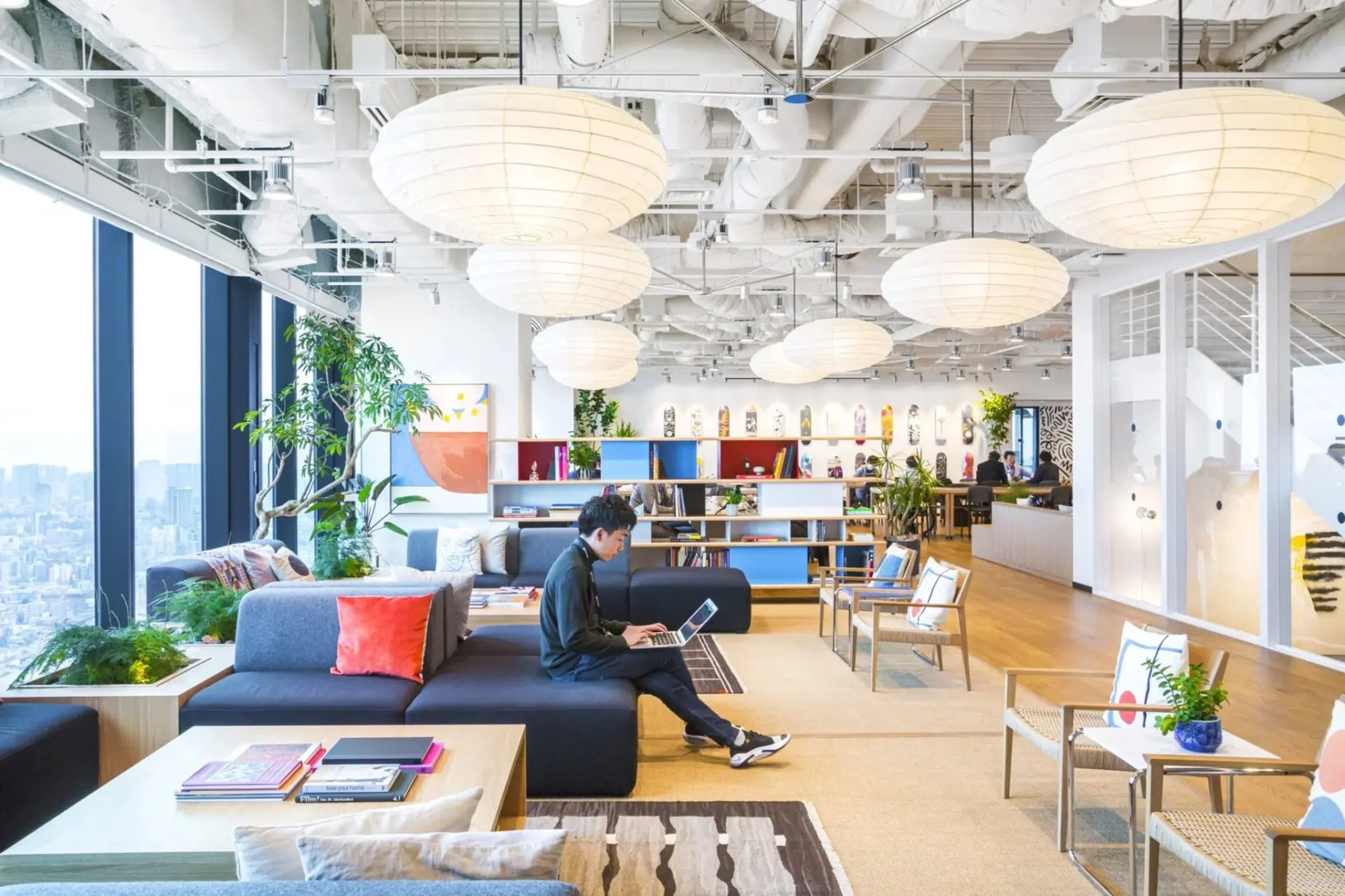
Tokyo offers four distinct ways to hold an office, and they differ less in monthly cost than in what they commit you to. Choosing the wrong one is expensive in ways that do not show up in the headline figure — usually in deposits, notice periods and restoration obligations.
Virtual address
A registered address with mail handling and, usually, some meeting-room credit. It exists to satisfy the requirement that a company have a registered address, and to give a business a presentable one. Our Tokyo catalogue lists this product across 200 buildings. It suits a company being incorporated, a foreign business testing the market, or a fully remote team. It does not give you anywhere to work.
Coworking
A desk in a shared room — hot or fixed — with internet, meeting rooms and reception included, usually on a monthly rolling contract. The catalogue carries 170 coworking options in 170 buildings, starting from ¥40,000 a month. It suits one to five people, teams whose headcount is still moving, and anyone who values being able to leave at a month's notice. The limits are acoustic and practical: confidential calls are awkward, and you cannot put your own server or your own branding in a shared room.
Serviced office
A lockable private room inside a managed centre, with the same services bundled. Our catalogue lists 459 private office options. It suits teams of roughly three to thirty that need a door, a fixed address and predictable billing, without running a lease. Cost per square metre is higher than a conventional lease; total cost of occupancy, once fit-out, internet, furniture and management fees are counted, frequently is not.
Conventional lease
Space taken directly from the building owner, typically on a two-year term. The lowest cost per square metre and the highest commitment: a security deposit commonly running to several months' rent, your own fit-out, your own utility and internet contracts, and an obligation to restore the space at the end. It suits established companies with stable headcount taking meaningful space, where the per-square-metre saving outweighs the flexibility given up.
How to decide
Three questions settle it in most cases. How certain is your headcount twelve months out? If the honest answer is "not very", the flexibility of coworking or a serviced office is worth its premium. How much capital can you tie up before moving in? A conventional deposit is the largest single barrier for a young company. Does the space need to be yours — branded, lockable, wired to your own specification? If yes, a shared desk will not do, whatever it costs.
Comparing in one place
All four products sit in the same catalogue — 1,251 listings across 188 buildings — so you can see them against each other by ward and budget rather than on separate sites. Start with the Tokyo office listings, or go straight to an operator such as Regus, which runs 18 buildings across the central wards.